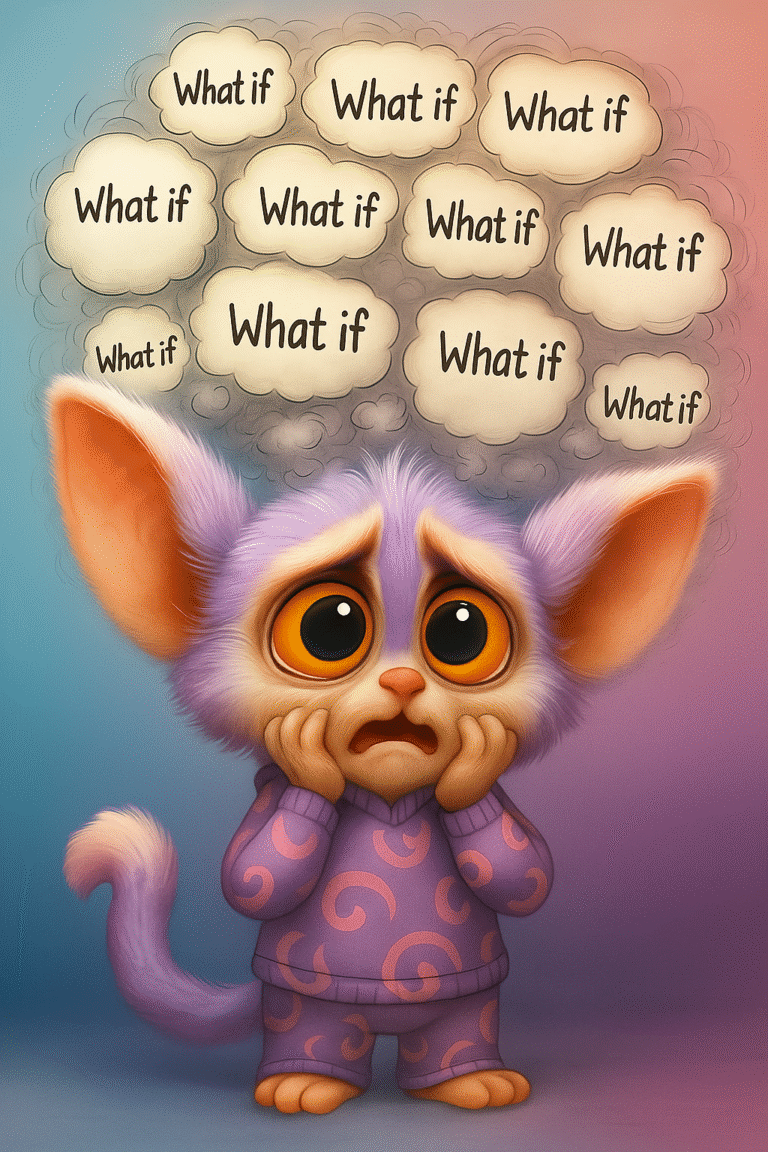
How to Stop Overthinking at Night When Your Brain Won’t Shut Off
3am thoughts
You finally get into bed, and your brain decides now is the time to review your entire life. The thing you said on Tuesday. The price you should’ve charged. The email sitting there unanswered. The post you nearly published and then pulled back. Overthinking at night can make a small moment feel like proof that everything is going wrong.
I know this pattern well, and I also know it’s expensive. It steals sleep, burns tomorrow’s energy, and turns one quiet data point into a full-blown court case in your head.
Why the 3 a.m. audit feels so convincing
When I’m exhausted, my brain doesn’t sound thoughtful. It sounds certain.
That’s the part that catches so many women out, especially if you’re two or three years into business, raising teenagers, carrying the mental load, and trying to keep showing up online without feeling like your chest is closing. At night, there is no counterargument. No friend saying, “That is not what this means.” No husband rolling over to tell you you’re being ridiculous. It’s just you and the loudest version of your fear.
Overthinking gets mistaken for depth. It isn’t. It’s a loop, not progress. It’s a treadmill. Lots of motion, no distance.

This matters because the cost isn’t only the lost sleep. It’s the next day too. You wake up heavier. Less clear. More likely to avoid posting, delay the email, undercharge, or question whether you’re even cut out for business at all.
I’ve seen this in myself and in so many women who assume the problem is discipline. It usually isn’t. It’s not a lack of knowledge either. Most of us already know what to do. The freeze happens because a tired brain starts treating uncertainty like danger.
And once that happens, every unfinished task suddenly sounds like evidence against you.
Meet Catastrophe Cathy, the voice that turns silence into proof
I call that voice Catastrophe Cathy. She’s one of those inner boardroom voices that shows up when I’m tired, stretched thin, or waiting for a response.
She loves the night shift because silence gives her space. A quiet inbox. A post with low engagement. A launch day that feels slower than I wanted. A week with no inquiries. Cathy takes each of those moments and turns them into a verdict.
Her favorite triggers are painfully ordinary:
- a post that didn’t get shared
- a day with no sales
- a message that hasn’t been opened
- a quiet week in the business
- a stretch where I feel behind everyone else
What makes Cathy dangerous is her language. She talks in “always,” “never,” and “this proves it.” She doesn’t say, “I’m worried this might not work.” She says, “This isn’t working.” She doesn’t say, “I’m feeling unsure.” She says, “I know this is going to go badly.”
The three moves Cathy uses every time
First, she tells fortunes and calls them facts. One slow day becomes a prediction about the whole future. The verdict arrives before any real evidence does.
Second, she magnifies. A small wobble becomes a disaster. One unopened message becomes “nobody wants what I offer.” One quiet post becomes “people have stopped caring.”
Third, and this is the sneakiest one, she uses feelings as proof. I feel panic, so it must be bad. I feel exposed, so I must be unsafe. I feel ashamed, so I must have done something shameful.
Feeling like it’s falling apart is not the same as it falling apart.
That distinction sounds simple. At 3 a.m., it doesn’t feel simple at all. But naming Cathy changes something. The thought stops sounding like truth and starts sounding like a pattern. And that is where I get some control back.
The first thing I do is stop scanning for fires
I don’t beat Cathy by arguing harder. I beat her by changing what my brain is scanning for.
Most of us are not naturally scanning for wins. We’re scanning for problems. That’s what happens when you’re a mom, running a business, remembering school stuff, dinner, client work, content ideas, money, laundry, and whether the teen who said “fine” was actually fine. The wins get buried, not because they don’t exist, but because I don’t stop long enough to register them.
So the first thing I practice is a 60-second win scan before bed.
The question is simple: What three things went even a little bit right today?
Not heroic things. Not gold-star things. Just movement.
- In business, maybe I sent the message I’d been avoiding, posted before I felt ready, or looked at numbers instead of hiding from them.
- In family life, maybe my teenager talked to me in full sentences, dinner happened without drama, or I stayed calm in a moment that usually hooks me.
- For myself, maybe I followed through while tired, took a walk, drank water, or stopped rewriting the same caption for the fifteenth time.

That tiny practice changes the question from “What did I do wrong?” to “What did I do that moved something forward?” And that shift matters more than people think. Small visible wins rebuild self-trust faster than giant plans ever do.
If you’re watching the video version, I mention a free app in the description that helps support this habit. But pen and paper works. Notes app works. Three lines on the back of a receipt works. The point is not the tool. The point is interrupting the audit before it starts.
The flip strategies I use when Cathy gets loud
The win scan helps, but Cathy doesn’t always pack up and leave. Sometimes she comes back with, “This proves you’re behind,” or, “This is why nothing changes.” That’s when I use a few flips that keep one bad moment from becoming a case against my whole business.
Separate the fact from the forecast
This one is huge. I write what happened, then I write what my brain says it means.
Here’s what that looks like:
| Fact | Forecast |
|---|---|
| My post got low engagement | Nobody cares about my business |
| One launch day was quiet | My offer is wrong and I should scrap it |
| A client hasn’t replied yet | I’ve messed this up |
That second column is where the drama lives. It’s also where the mind-reading lives. Silence is not disapproval. A quiet post is not rejection. One unsubscribed email does not mean you’ve ruined your brand. Often, it means one person left. That’s all.
I’ve found it helpful to create closure around decisions too. This piece on cognitive training for entrepreneurs makes a good point about writing decisions down so your brain stops reopening the file all night.
Use the three-data-point rule
I don’t let Cathy build a life sentence out of one result.
One quiet launch is one data point. One low-like post is one data point. One hard week is one hard week. I need at least three results showing the same pattern before I call it a trend.
That matters because tired brains love final answers. They want to pivot, scrap the offer, lower the price, disappear from Instagram, or quit by midnight. I don’t do that anymore. No big business decisions from one emotional data point.
One result is one result. It’s not a verdict.
There’s a similar idea in this article on how founders stop overthinking, and I agree with it: a thought doesn’t need endless attention unless new information has arrived.
Size the problem honestly
When a thought still feels loud, I rate the actual problem.
Tiny means uncomfortable, but not damaging. Medium means it needs attention and a next step. Big means it’s serious and rare.
Most of what Cathy screams about at 3 a.m. is tiny. Sometimes medium. Almost never big.
That one typo? Tiny. A slower-than-I-hoped sales day? Usually tiny or medium. A hard conversation I need to have? Medium. Something truly serious? Rare.
This helps because Cathy has no middle setting. Everything is either fine or catastrophic. Real life has a middle. Most business problems live there.
Build a brag bank, because 3 a.m. doesn’t need a pep talk
When Cathy gets loud, I don’t need fake positivity. I need proof.
That’s why I keep a brag bank (I go into the why in more detail here). It’s a place for evidence that I’m capable, useful, and able to follow through. Screenshots of kind messages. Client wins. Thank-you notes. Sales. Feedback. Times I posted while scared. Times I came back after a gap instead of disappearing for good.
A brag bank can hold things like:
- screenshots of praise or client feedback
- proof of sales, inquiries, or replies
- messages that show your work helped someone
- notes about moments you followed through when it would’ve been easier not to
This matters because confidence doesn’t come from trying harder to believe in myself. It comes from evidence. I trust myself more when I can see, in black and white, that I’ve handled discomfort before and survived it.
That also applies to visibility. Your nervous system learns safety through repetition. It learns, “I posted and didn’t die.” “I sold and didn’t implode.” “I was seen, uncertain, imperfect, and the world kept turning.”
So if you’ve had gaps, count the returns too. That has been one of the biggest shifts for me. Consistency is not never missing a day. It’s coming back. Again and again. The women who build calm consistency are not the ones who never wobble. They’re the ones who stop treating every wobble like a character flaw.
People are usually not judging you as harshly as your 3 a.m. brain suggests. And progress often starts stacking up before it feels visible.
What I do tonight if I want to stop overthinking
If I know my brain has been spicy lately, I don’t wait for bedtime and hope for the best. I give it a plan.
Before sleep, I do the 60-second win scan. Three lines, business, family, self. If a thought spikes after that, I write the fact and the forecast separately. If it still feels heavy, I ask whether this is tiny, medium, or big. Then I check whether I even have three real data points, or whether Cathy is trying to make one quiet moment mean everything.
If the noise is still there, I open the brag bank. Not for motivation. For evidence.
And if today was messy? I don’t create some dramatic restart plan. I don’t tell myself Monday will be different. I don’t make a giant promise I can’t keep. I look for one small action I can do tomorrow that proves I showed up.
That might be posting one thing. Replying to one email. Looking at one number instead of avoiding it. That’s enough.
The goal isn’t to become fearless before bed. The goal is to stop letting a tired brain write stories your real life hasn’t confirmed.
When the house is finally quiet
The late-night audit feels convincing because you’re tired, not because it’s true. Your brain is scanning for threats in the silence. That’s what brains do.
What helps me is not fighting every thought. It’s giving my mind better evidence to work with: wins, facts, patterns, proof. That is how I stop overthinking without pretending I never feel fear.
Tonight, when my head hits the pillow, I want evidence on my side. Not panic. And I’m not handing Cathy the clipboard.