
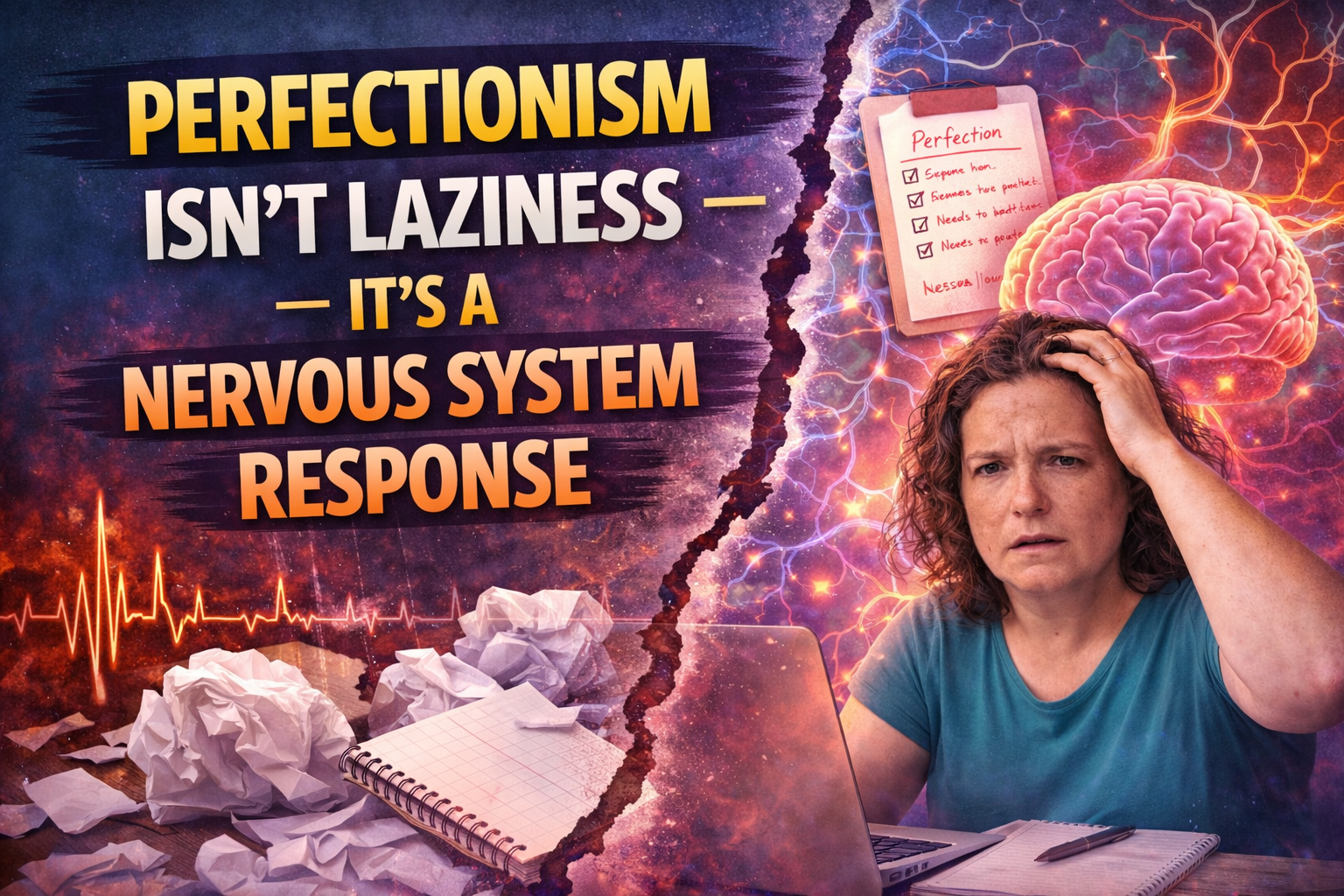
Perfectionism in Business: Why It Keeps You Stuck (and How to Move Again Without Burnout)
TL;DR: If perfectionism is keeping you stuck in your business, it’s not because you’re lazy or unmotivated. It’s often a protective response from your nervous system—and working with it, not against it, is how consistency actually returns.
If you:
- Overthink before you start
- Tweak things endlessly instead of finishing
- Delay “just until it feels right”
- Then feel annoyed with yourself for not doing the thing
This isn’t a motivation problem.
And it’s not because you’re suddenly bad at business.
If you’re a mum building an online business—while juggling tweens, teens, school runs, and the general chaos of real life—and you’ve been struggling to stay consistent with posting, selling, or showing up lately, you are not alone.
Somewhere between wanting to do something and actually doing it, there’s a pause.
A hesitation.
Everything tightens. All those good intentions grind to a halt.
That gap is where perfectionism in business sets up shop.
Why Pushing Harder Makes Perfectionism In Business Worse
At first, perfectionism can look like a good thing.
Caring about quality. Wanting to do things properly. Being responsible.
But when perfectionism goes into overdrive, it stops being helpful and becomes exhausting.
And here’s the part most people miss:
Pushing harder is rarely the solution.
White-knuckling your way through resistance often leads to burnout—or to avoiding the thing altogether. Posting less. Selling less. Showing up less.
That’s because perfectionism isn’t a discipline issue.
It’s a safety issue.

Perfectionism Isn’t a Flaw — It’s a Protector
A more useful way to think about perfectionism is not as a personality trait, but as a protective strategy.
It’s fear dressed up in a very convincing, very productive-looking mask.
Often, that intense need for things to be just right is rooted in:
- A fear of judgement
- A fear of getting it wrong
- Or a need to control something in a world that feels unpredictable
This is a biological response, not a character flaw.
You might hear this inner voice telling you to wait, tweak, or double-check one more time.
In my work, this voice is sometimes called Perfect Paula.
She’s not the enemy.
She’s an inner protector who learned, somewhere along the way, that being perfect was the safest way to avoid criticism or failure.
The problem isn’t her.
It’s that she’s been allowed to sit in the driver’s seat and run the whole business.
Research shows that when our bodies perceive stress, the nervous system activates a survival response that can tighten focus and slow action — helping explain why perfectionism feels so resistant and automatic.
Awareness Is Where Things Start to Shift
Overcoming perfectionism isn’t about fighting it or trying to get rid of it.
The first step is simply learning to notice when it shows up.
That’s a big shift.
We move from fixing and forcing… to observing.
The moment you can name the familiar spiral—the overthinking, the delaying, the checking your work for the tenth time—you step slightly outside its control.
Awareness creates space.
And space creates choice.
Gentle Tools to Help You Move Again
These tools aren’t about making yourself do anything.
They’re about releasing the pressure that keeps you frozen, so movement becomes possible again.
Tool 1: The Emotional Weather Report
Instead of asking, “Why am I like this?” try asking:
What’s happening right now?
Then describe it like weather.
Is it stormy? Foggy? Heavy? Calm?
You don’t need to analyse it or fix it.
Just noticing the emotional weather helps your nervous system feel seen—and that alone can lower the intensity.
You don’t need to wait for a full perfectionism spiral to use this.
The earliest flicker of hesitation is the perfect moment.
What This Looks Like in Real Life
You’ve written a post or an email.
You read it once. Then again. Then start tweaking sentences that were already clear.
That familiar tightness creeps in.
Instead of pushing through, you pause and check the emotional weather.
You notice it feels foggy—not wrong, just uncertain.
So you decide to leave the post as it is, schedule it anyway, and step away.
That one small choice builds evidence:
I can move forward without everything being perfect.
That’s how momentum starts—quietly, without force.
If you want to complement this with practical steps to get moving even when overwhelmed, check out how micro-wins build momentum here
Tool 2: The Balloon of Letting Go
Perfectionism is often fuelled by quiet, looping thoughts like:
“I should be further along by now.”
Write those thoughts down.
Then imagine placing them into a balloon and letting it float away.
By naming the pressure and placing it outside of you, it begins to lose its grip.
You’re telling your nervous system:
You don’t have to hold all of this at once.
What Is a Safe Visibility Rhythm?
A safe visibility rhythm is a way of showing up in your business that your body actually trusts. Instead of pushing yourself to be consistent through pressure or willpower, you choose small, predictable actions with clear start and end points—so your nervous system knows what’s coming and doesn’t panic. When visibility feels low-stakes and contained, perfectionism loosens its grip, hesitation shortens, and consistency becomes sustainable. Over time, this steady rhythm builds real self-trust, making it easier to show up again without needing confidence first.
Consistency Comes From Safety, Not Discipline
Most of us were taught that consistency comes from willpower.
But sustainable consistency comes from safety.
When something is predictable, low-stakes, and contained, your nervous system can relax.
That’s what allows you to choose momentum over mastery.
Perfectionism tells you that you must be ready before you begin.
But movement is what creates readiness.
Small, repeatable actions build skill.
Confidence becomes a by product—not a requirement.
This ties closely to ideas in Why confidence matters in your business — confidence acts like fuel, not force.
When These Tools Aren’t Enough
For many people, these gentle practices are enough to restart movement and consistency.
But it’s important to say this clearly:
If your perfectionism is deeply tied to chronic anxiety, unresolved trauma, or long-term burnout, self-guided tools alone may not be sufficient.
In those cases, working with a therapist, coach, or other trained professional can provide the additional support your nervous system needs.
This isn’t failure.
It’s recognising when your system needs more safety than a DIY approach can offer.
If Perfectionism Is Tied to Self-Doubt
For many women, perfectionism and impostor syndrome go hand in hand.
That urge to wait until things are perfect is often the same voice whispering:
- “Who am I to say this?”
- “What if they realise I don’t know enough?”
- “I should probably be further along by now.”
Psychology researchers note that impostor syndrome and perfectionism often go hand in hand, with the fear of making mistakes or not performing perfectly feeding self-doubt.
If that sounds familiar, I created Impostor Detox, a free five-day reset designed to help you spot and quiet those self-doubt patterns before they derail your momentum.
It’s short, practical, and designed to fit into real life—even if you’re building a business between school runs and reheated dinners.
When You’re Ready for Ongoing Support
Awareness and gentle tools can get you moving again.
But for many women, the biggest shift comes from being supported consistently—not just in moments of crisis.
That’s why I created the Self-Doubt Membership.
It’s for women who understand the mindset work, but don’t want to keep starting over.
Inside, we focus on building self-trust, calming the nervous system, and creating safe visibility rhythms so progress doesn’t rely on motivation or pressure.
Final Thoughts
This approach isn’t about avoiding hard things.
It’s about building real self-trust.
You’re allowed to protect your energy.
You’re allowed to move at a pace your body can sustain.
That’s not avoidance.
That’s how you build consistency that actually lasts.
Key Takeaways
- Perfectionism in business is often a safety response, not a flaw
- Pushing harder usually increases burnout and avoidance
- Awareness creates choice—and choice restores momentum
- Consistency grows from safety, not discipline
- Small, repeatable actions rebuild self-trust over time
Is perfectionism in business actually a bad thing?
Perfectionism isn’t bad in itself — it often starts as a desire to do things well. It becomes a problem when it stops you from finishing, posting, or moving forward.
When perfectionism shifts from quality to avoidance, it quietly drains consistency and confidence.
Why does perfectionism make me freeze instead of try harder?

Because perfectionism is usually a safety response, not a motivation issue.
When your nervous system senses risk — like judgement, failure, or visibility — it can slow or shut down action to protect you.
Freezing is a form of self-protection, not laziness.
How is perfectionism different from procrastination
Procrastination avoids discomfort by putting things off. Perfectionism avoids discomfort by trying to control the outcome.
They often look similar on the surface, but perfectionism usually comes with high standards, overthinking, and self-criticism rather than disinterest.
What if I understand all this but still can’t be consistent?
That’s very common. Awareness is the first step, but consistency usually returns when your body feels safe enough to repeat action.
This is why small, predictable routines — like a safe visibility rhythm — work better than relying on motivation or discipline alone.
Can perfectionism and impostor syndrome show up together?
Yes — very often. Impostor syndrome fuels the belief that you’re not ready or not enough, while perfectionism tries to protect you from being “found out.” Together, they can keep you stuck in preparation mode instead of action. Addressing both gently is key.




One Comment