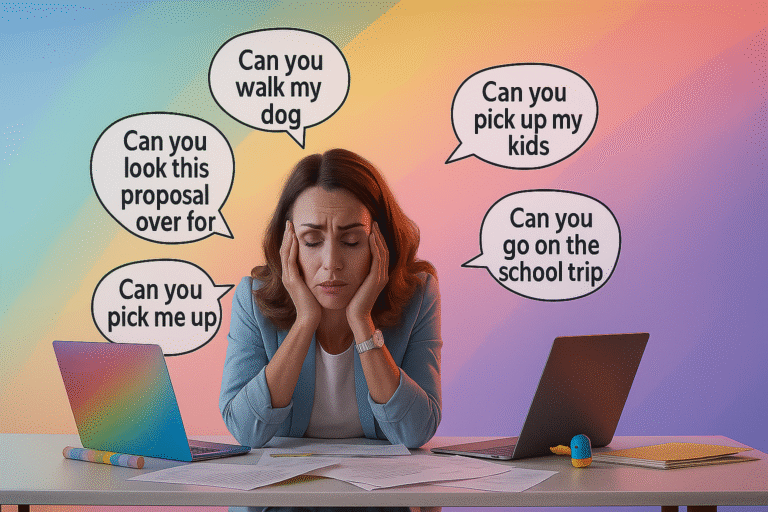
Confidence on Low Energy Days: The Nervous System Truth for Mom Entrepreneurs
Some days, you wake up ready to take on the world.
Other days, you’re a mom growing a business and your brain is buffering, your knees sound like velcro, and you’re running on vibes and dry shampoo.
Here’s the part you need to hear in big, bold letters: when your energy drops, your confidence often drops too. Not because you’re “bad at mindset.” Not because you’re secretly lazy. Not because you’re not cut out for business.
It’s biology.
And once you get that, you can stop treating yourself like a problem and start supporting your nervous system like the actual CEO it is.
Why low energy days can crush confidence (and why it’s not a character flaw)
Low energy days are normal, especially if you’re parenting tweens or teens, building a business, and trying to remember if you drank water or just thought about water.
When your body is tired, stressed, overstimulated, or hormonally hijacked (hi, perimenopause), your brain doesn’t respond with, “No worries, let’s confidently launch a new offer!”
Your brain responds with conservation.
Your brain needs fuel to access things like:
- clear decision-making
- motivation
- emotional regulation
- creative thinking
- steady focus
When that fuel is low, your nervous system shifts into what you can think of as conservation mode. It’s your brain trying to protect you from effort, risk, visibility, judgment, and pain. In other words, it’s not trying to help you grow, it’s trying to keep you safe.
That protective mode can light up the same “uh-oh” circuitry behind imposter thoughts (the fear-based loop that whispers, “Who do you think you are?”). If you want a deeper research read on the imposter experience and its roots, this paper is a solid starting point: Focusing on the neuro-psycho-biological and evolutionary underpinnings of the imposter syndrome (Frontiers in Psychology).
So instead of confidence, you may notice:
- Hesitation (even on things you normally do fine)
- Foggy thinking (what was the password, what was your name)
- “I’ll do it later” thoughts (translation: not today, Satan)
- Emotional wobbliness (teary, snappy, or both)
- Shrinking and freezing (avoiding anything that requires effort)
Here’s the kicker: confidence is a nervous system state, not a personality trait.
You don’t “have” confidence like it’s a permanent eyebrow shape. Your body experiences confidence when your system has enough capacity to feel safe, clear, and resourced.
And yes, that means your energy and confidence are linked.
Also, for the record, this line deserves to be framed on the wall of every mom entrepreneur: “When your nervous system is held together with hope and dry shampoo.”
Stabilize your system before you try to “fix” anything
On low energy days, you don’t need a pep talk that sounds like it was written by a golden retriever in a blazer.
You need self-support, not self-judgment.
Before tools, before strategy, before you try to “push through,” stabilize your system first. A simple way to do that is to label what’s happening internally, so your brain stops spinning stories and starts locating reality.
The 20-second Emotional Weather Report (use a worksheet or blank paper)
Grab a piece of paper and write: “Today’s internal weather is…”
Then pick one:
Stormy. Cloudy. Foggy. Drizzly. Surprise patch of sun.
That’s it.
This might sound almost too simple, but naming your emotional state can reduce threat response in the brain (the amygdala is involved in fear and threat processing). If you want a more technical look at how stress systems and the brain-body loop play together, this open-access article is worth bookmarking: Full-text article on imposter syndrome underpinnings (PMC).
Once you name the weather, your nervous system often softens a notch. You’re no longer fighting the day. You’re orienting to it.
On low energy days, the goal is not high performance. The goal is clean communication and gentle self-direction.
Plug-and-play lines for low energy business days (when your brain feels like mashed potatoes)
There are days you can write a sales email in 12 minutes and it hits like magic.
And there are days you stare at your screen like it owes you money.
These lines are for the second kind of day.
They’re designed to help you stay visible, communicate clearly, and keep momentum without forcing yourself into a high-energy persona that isn’t available. No hype. No spiraling. No 17-paragraph captions to prove you’re credible.
1) The Low Energy Truth Line
Use this when you need to show up, but you can’t perform.
Try:
“Here’s one thing that’s been helping me lately.”
“Here’s a small shift that changed everything for me.”
Why it works: it positions you as a grounded, relatable authority. You’re not claiming to have a perfect life. You’re offering something useful from real experience.
Example:
“Here’s one thing that’s been helping me lately: I pick one tiny task that moves my business forward, then I stop. My brain wants a 12-step plan, but my nervous system needs a win.”
That’s content. That’s connection. That’s leadership, even if you’re wearing yesterday’s mascara.
2) The No Drama Offer Line
Use this when you want to sell without turning it into a whole emotional production.
Try:
“If this is something you want help with, here’s how we can work together.”
Why it works: it removes pressure on both sides. You’re not begging. You’re not bracing for rejection. You’re making a calm invitation.
Example:
“If this is something you want help with, here’s how we can work together: I have a membership where we practice nervous system-friendly business habits, so you can stay consistent without burning out.”
Simple. Clean. No jazz hands required.
3) The One Micro Win Reset
When you’re tired, your brain tends to think in extremes: “I can’t do anything today, so I’ll do nothing.”
Micro wins interrupt that.
Ask yourself:
“What’s the smallest step I can take that moves money closer?”
Why it works: micro wins build identity. Identity builds confidence. Even on low energy days.
Examples of “moves money closer” that still count:
- Send one follow-up message you’ve been avoiding
- Review one lead, one application, one inquiry
- Write one sentence for your offer page
- Post one clear call to action (not a novel)
This is how you stay in motion without asking your body for energy it doesn’t have.
4) The Capacity Check-In Line (for DMs, emails, and client chats)
This one is gold, especially if you’re the kind of woman who tries to be “easy to work with” and accidentally becomes a 24/7 help desk.
Try:
“Today’s a low capacity day, so I’ll keep this simple.”
Why it works:
- It removes guilt (you’re not “failing,” you’re pacing)
- It reduces pressure (no one expects a 10 out of 10 performance)
- It builds authority through strong boundaries
Example:
“Today’s a low capacity day, so I’ll keep this simple. Here are the two options, tell me which one you prefer, and I’ll take the next step.”
Clear. Direct. Respectful. And it teaches people how to work with you.
A visual add-on: the Waves of Emotions idea
If your brain is too tired to label feelings with words, go visual.
On a page, draw 3 to 5 wave shapes (like simple ocean waves). Then shade or color the wave that matches how intense today feels.
The point is not art. The point is a quick visual anchor that helps your nervous system go, “Oh. This is where we are.” That usually makes the next micro step easier.
Your 5-minute visibility plan (without burning out)
You can stay consistent in your business on low energy days with five minutes.
Not 50. Not “a whole morning.” Five.
This is for the days when you want to stay visible, keep selling, or at least stay in motion, but you don’t have the bandwidth for a full content plan.
Step 1: Ground your nervous system (60 seconds)
Do a quick “rooted truth reset.”
Put one hand on your heart and one hand on your belly.
Breathe like this:
Inhale for 4 counts.
Hold for 2 counts.
Exhale for 6 counts.
Then say (out loud if you can):
“This is just an old story trying to protect me.”
This matters because imposter thoughts often show up as protection, not truth. Your system senses risk (visibility, judgment, effort), and it tries to pull you back.
If you want more reading on how imposter feelings are discussed in research, this PDF is the full paper version: Frontiers in Psychology PDF on imposter syndrome underpinnings.
Step 2: Choose one visibility action (2 minutes)
Pick one. Not five. One.
Options that count:
- Post one sentence (a real sentence, not a thread)
- Reply to one DM
- Share one win (tiny wins welcome)
- Share your offer with one person
- Write one headline for a post you can finish later
This is the behavioral blueprint part: behavior first, confidence follows. You don’t wait to “feel ready.” You do the smallest visible action that matches today’s capacity.
Step 3: Use one regulation tool (1 to 2 minutes)
Pick one tool to help your body settle so your brain can think again.
Emotional Weather Report: Name the day’s forecast (stormy, foggy, drizzly).
Waves of Emotions: Color the wave that matches your current intensity.
Jar of Positive Affirmations: Write one affirmation that’s believable, not delusional.
Believable matters.
Your nervous system will reject affirmations that feel fake. Then you’ll feel worse, because now you’re exhausted and “bad at affirmations,” which is truly not a job anyone asked for.
Try something like:
- “I can take one small step today.”
- “I don’t have to do this perfectly to do it well.”
- “My capacity is different today, and I can still lead.”
The goal is reduced resistance and a little more mental space for the next step.
Step 4: Close with one supportive sentence (10 seconds)
When you’re done, say:
“This was enough for today.”
Then close the laptop tab. Stop scrolling. Walk away.
This builds self-trust, which is the foundation of confidence on any day. Especially the messy ones.
If you teach your nervous system that showing up equals punishment, it will keep slamming the brakes. If you teach it that showing up can be small and safe, it gets easier to show up again.
Turn low energy days into your new normal (without white-knuckling it)
If these tools made you feel even a little lighter, steadier, or more capable, that’s not an accident. You supported the system that runs the whole show.
Low energy days don’t need to derail your business. They just require a different operating plan.
The themes here are simple, but they’re powerful when you practice them consistently:
- Micro wins instead of pressure
- Nervous system resets instead of shame spirals
- Clean communication instead of overexplaining
- Boundaries that protect your capacity
And if you have access to ongoing support (like a weekly membership, lessons, or a workbook focused on imposter thoughts), this stuff starts to feel less like an emergency fix and more like your baseline way of working.
FAQ: Confidence, low energy, and running a business as a mom
Why do I feel less confident when I’m tired?
Because your brain needs energy for clarity, emotional regulation, and decision-making. When energy is low, your nervous system leans toward protection and conserving resources, which can look like hesitation, avoidance, and imposter thoughts.
Is it normal to feel more anxious or foggy in perimenopause?
Yes. Hormone shifts can affect sleep, mood, stress tolerance, and focus. That combo can make low energy days hit harder, which can make confidence feel harder to access too.
What if I don’t have time for nervous system tools?
Use the five-minute plan. One minute of breathing, two minutes of visibility, one minute of regulation, and a closing sentence. The point is not to do everything, it’s to stay connected to yourself and your business.
What should I post when I have low energy but need to stay visible?
Use the Low Energy Truth Line: “Here’s one thing that’s been helping me lately,” or “Here’s a small shift that changed everything for me.” Keep it real, keep it short, and skip the hype.
How do I stop feeling guilty for having low capacity days?
Name reality and set a boundary. Try: “Today’s a low capacity day, so I’ll keep this simple.” Guilt usually shows up when you expect high performance from a low-capacity body. Adjust the expectation, then act from there.
Conclusion
Low energy days aren’t proof you’re failing, they’re proof you’re human (and probably doing a lot). When confidence drops with energy, it’s often your nervous system trying to protect you, not your “mindset” falling apart.
Support your system first, then choose one small action, then call it done. That’s how you build self-trust, and self-trust is where confidence comes from, even when the day is drizzly and your brain feels like mashed potatoes.